An introductory session on Teaching for Thinking
Reflections on the UQ Critical Thinking Schema
By Lucia Ravi, Student Learning Librarian, and CoP RBL Convenor, University of WA.
Engaging students in inquiry and research has been recognised as a core way to focus learning on the development of higher order critical thinking and problem solving. But embedding critical thinking research into the curriculum is often problematic, marked by a lack of precision and intentionality in pedagogical practice.
The University of Queensland Critical Thinking Project (UQCTP) has developed an explicit inquiry framework (Teaching for Thinking, or T4T) to help communicate critical thinking processes and more formally assess them. This approach has been successfully trialled in many education contexts, including in partnerships with UCLA and Pepperdine universities, California and Simon Fraser University, British Columbia.
As a pedagogical approach it provides a tangible and actionable way to respond to the identified need to shift away from output-based assessments towards performance-based approaches, an imperative in an age of AI.
Dr Peter Ellington, whose research underpins the University of Queensland’s Critical Thinking Project presented on behalf of the ACUR and UWA 4th Colloquium Seminar Event on the 2nd July 2025.
On this page, we offer a summary of how the ideas presented by Dr Ellerton link to Research Based Learning (RBL) as a whole of curriculum pedagogical approach.
We are very grateful to Dr Ellerton for allowing us to share his presentation notes, CT Schema Handouts and recording from the session.
UQ’s CT project aligns with ACUR’s view that meaningful student engagement in inquiry and research thinking provides the means to facilitate the development of students’ critical thinking. Within Research Based Learning (RBL) approaches inquiry represents the continuum of thinking processes required to both construct new knowledge and to learn something new. Engaging students in inquiry provides the pedagogical approach for a shift away from output-based assessments towards performance-based approaches, an imperative in an age of AI.
Links between Research Based Learning (RBL) and Critical Thinking (CT)
There are many important reasons ‘why’ academics’ choose to embed research into teaching for their undergraduate student cohorts – for some it is to give students a taste of research, for others a core aim is to ensure students bring a scholarly and evidence informed mindset to their professional future roles. However, overall the stated learning outcome of research based learning is the development of students higher order critical thinking and problem solving capabilities (Healey & Jenkins, 2009) . An increasingly important pedagogical approach given contemporary calls for a shift in focus on the’ ‘processes of learning’ as a way to mitigate the risks of Generative AI to the validation of student outcomes (Lodge et al., 2023).
But how exactly does RBL as a pedagogical approach ensure this focus on the development of students critical thinking? Especially when any dive into the literature demonstrates just how ambiguous and fuzzy our conceptualisation of what critical thinking is (Ellerton, 2015). As identified in the research literature, achieving the critical thinking learning aims associated with RBL within teaching practice is difficult (Brew & Mantai, 2017; Eiken & Wollscheid, 2016; Hughes, 2019).
As identified in the research literature, achieving the critical thinking learning aims associated with RBL within teaching practice is difficult (Brew & Mantai, 2017; Eiken & Wollscheid, 2016; Hughes, 2019). A wide range of internal and external factors have been identified. External factors include the more resource intensive requirements of facilitating and assessing a high value pedagogical. Additionally, teaching and assessing students thinking is a much harder learning outcome to facilitate than the testing of content knowledge associated with traditional pedagogies. This facilitation of critical thinking requires a philosophical alignment with interpretive pedaogical positions and teaching practices.
The UQ Critical Thinking Schema can support academics to address this potential gap in their teaching practices.
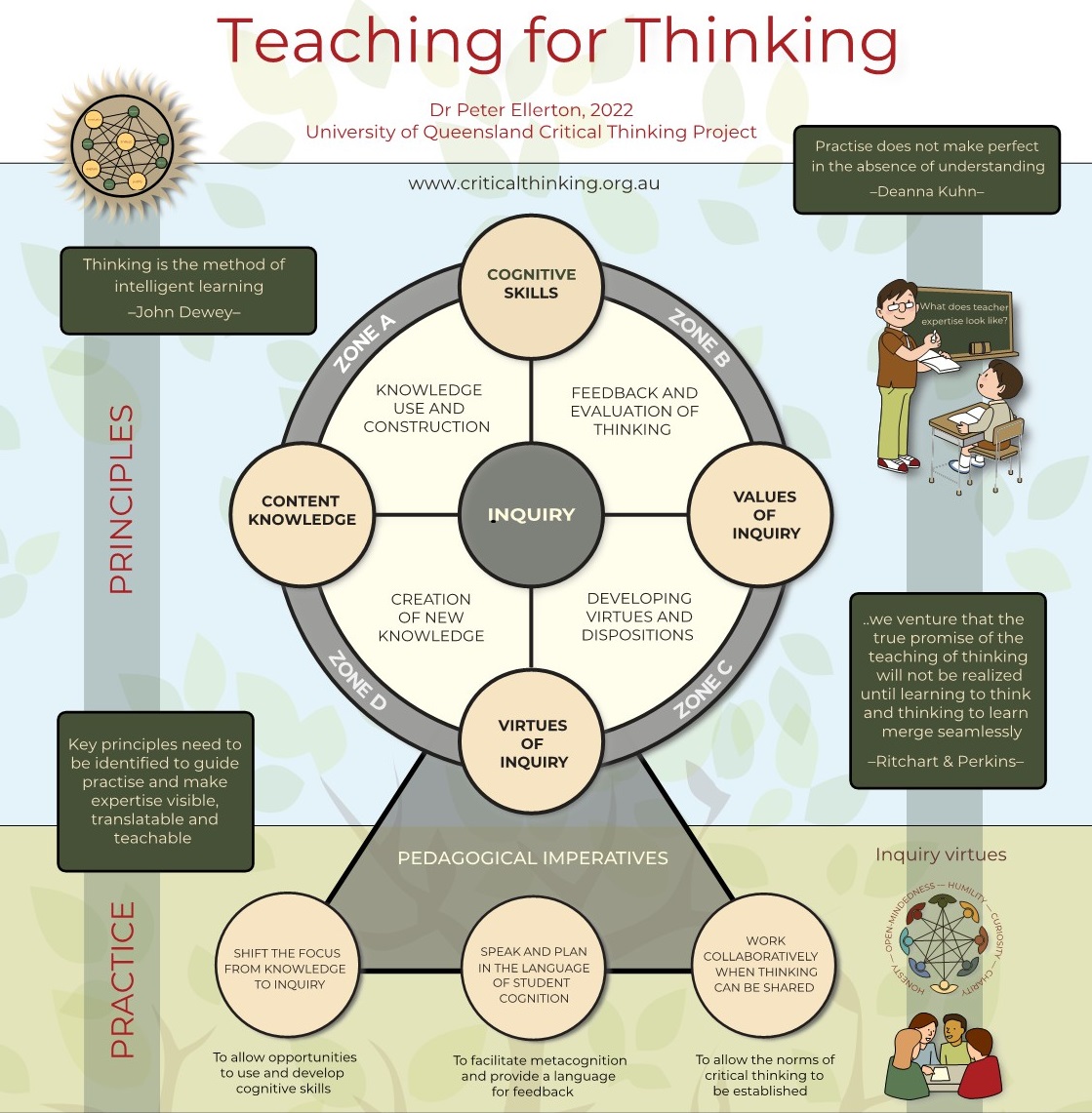
The Critical Thinking Schema developed by Dr Peter Ellerton and the research team at the University of Queensland CT Project is important because it aims to bring intentionality and precision to the teaching of critical thinking. It represents a potential missing link in core RBL theorists’ assertions that engagement in inquiry and research is of relevance to all university students and provides a way to transform curriculum (Boyer, 1990, Boyer Commission, 1999; Brew 2003, 2010, 2013; Healey & Jenkins, 2009). The CT Schema developed by UQ also places student engagement in inquiry as core to the development of critical thinking capabilities and similarly see facilitation of students’ deconstruction and construction of knowledge as applied within a given context way to achieve this focus on critical. Within RBL theoretical discourses however, the purpose of inquiry is framed in terms of broader questions related to the value of student engagement in disciplinary research to contemporary society. This provides an important lens through which RBL as a pedagogical approach shapes curriculum design choices which is not a framing found in the CT Schema.
Centrality of Inquiry to RBL and CT
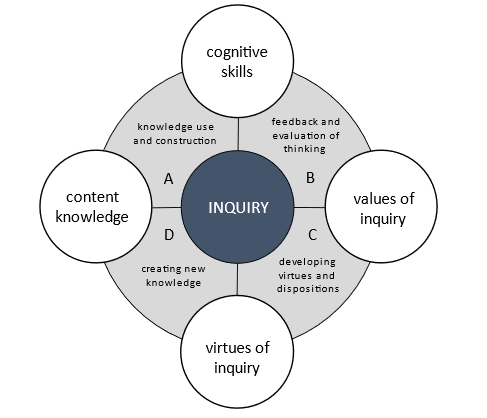
The CT Schema developed by the University of Queensland Project Team, provides a new model that can be used to guide the integration of inquiry and research thinking into curriculum to support the development of students’ critical thinking. The schema offers conceptual ideas of how content and metacognitive knowledge inter-relate and can be bought into teaching practice through the values and virtues of inquiry and a greater focus on describing cognitive skills. Together the schemas conceptual, praxis and practical elements aim to specifically describe how through inquiry students self-reflection and feedback on the quality of their thinking can be facilitated.
This centrality of inquiry within the Critical Thinking Schema developed by the UQ project team, aligns to RBL theorists’ views that cognitive processes required to learn, inquire and research are synonymous, albeit at different levels of refinement. That is that inquiry provides the pathway to help students to learn how to refine their reasoning and judgement. These claims can be understood if we think of learning as the connections we make between different ideas (Ellerton et al. 2024). These connections are made whenever we ask questions or inquire into gaps in our knowledge. At the core of being able to ask meaningful questions lies critical thinking – described by Ellerton (2025) as the “identification, analysis, evaluation and construction of arguments”. Within RBL pedagogy, this is achieved through an academics’ facilitation of their students’ research thinking in the context of disciplinary research questions and methodologies.
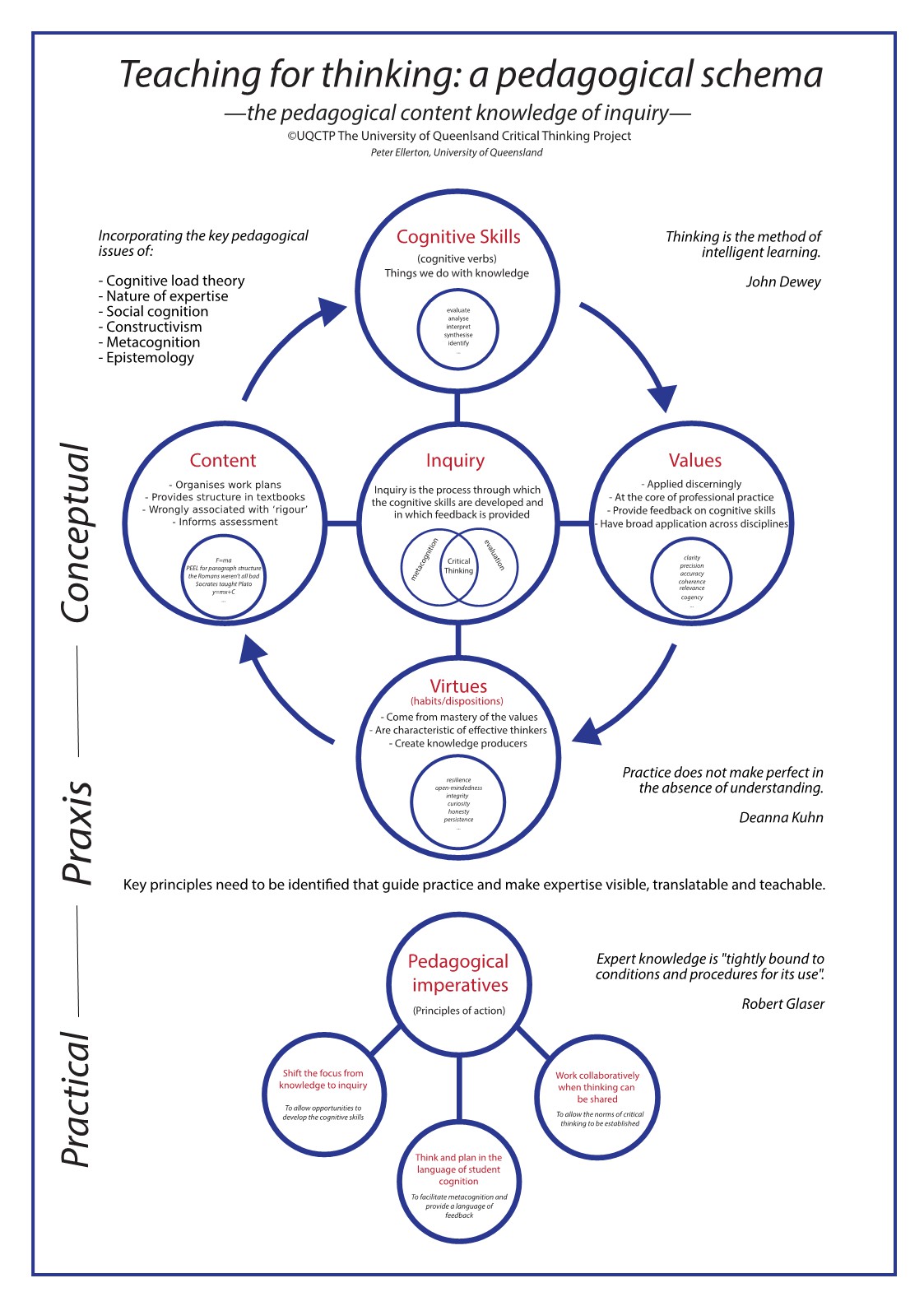
A curriculum designed to focus on critical thinking, using their CT schema, aims to facilitate students’ active experiential experience of how to use cognitive skills to engage with content knowledge. Feedback becomes the cognitive mirror here, enabling students to externalise and examine their own reasoning. When teachers frame feedback around the schema, they move beyond correctness to conversations about how students are connecting ideas, justifying claims, and evaluating evidence. The aim being to help students learn how to analyse, justify, evaluate and explain the basis of their assumptions and/or arguments as they critically think about and make connections between knowledge and application.
Having developed the focus of inquiry that aligns with your learning aims, and the types of intentions underpinning teacher facilitated questions, you are then in a position to use the values and virtues of inquiry to provide student feedback on their critical thinking.
Values, Virtues of Inquiry
As Ellerton (2018) points out, the complexity of supporting students to think critically is often under-estimated or not well articulated in pedagogical approaches. This is likely because thinking is complex; given that the types of cognitive skills required in any given context will be shaped by the nature of inquiry or research question; and that thinking critically often requires an awareness of the interplay between cognitions to also be developed.
The values and virtues of inquiry developed as part of the UQ Critical Thinking Schema, aim to specifically support teachers to facilitate the giving of student feedback about their thinking processes (Ellerton, 2018). Getting students to consider the quality of their inquiry is vital to learning, as it is the way in which the basis of choices and judgements used to construct their knowledge – the arguments and rationales used- can be reflected on and enhanced.
Providing feedback through the values and virtues of inquiry provides a language you can use to help students to develop their metacognitive awareness – their ability to reflect on and think about their cognitive choices (Ellerton, 2015). Metacognitive awareness is not only important to the development of critical thinking capabilities but is also central to students’ capacity to transfer and refine these thinking processes in new inquiry contexts.
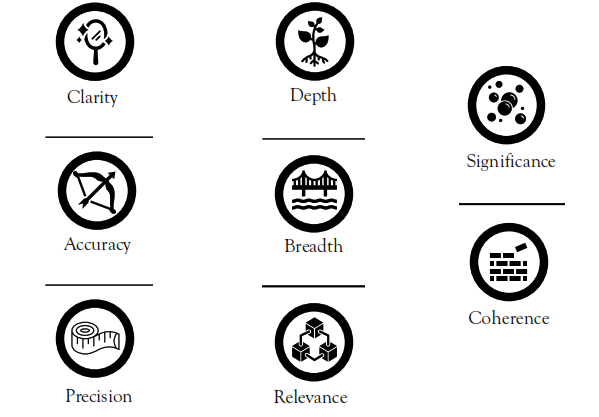
The Values of Inquiry developed to supplement the CT Schema, supports reflection on the quality of students’ assumptions and arguments in relation to a range of criteria. For instance, values of importance, discernment and application might be evaluated through a consideration of relevance and significance of the connections between information or data used. Values related to scope, perspectives and thoroughness might be evaluated in terms of breadth and depth of research. Logic, consistency and persuasiveness could be evaluated through a consideration of coherence and cogency. When feedback is structured around these values, it shifts from evaluative comments to dialogic prompts; questions that invite students to assess the quality of their inquiry rather than the correctness of their answers. This can foster greater personal motivation and sense of self-agency.
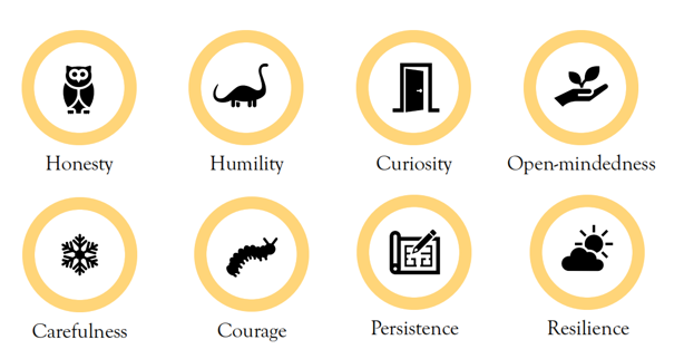
The Virtues of Inquiry developed acknowledges the importance of the affective domain in our critical thinking processes (Ellerton, 2018). As stressed by Ellerton et al. (2025) virtues help promote our students’ belief in the values of scholarly thinking – “to commit to the use of knowledge and evidence to analyse issues and find solutions in the face of complexity, ambiguity and uncertainty”. Virtues such as curiosity, open-mindedness, persistence and resilience underpin students’ capacity to commit to critical thinking mindsets. These same virtues also shape how students receive and respond to feedback. Feedback literacy, in this view, becomes as much about emotional labour and intellectual humility as it is about analytical rigour. Moreover, these affective dimensions of critical thinking foster students’ capacity to consider broader perspectives and engage with complex social contexts, expanding the scope of their inquiry questions and facilitating the identification of knowledge gaps.
Moving to teaching practice – the learning design choices required for a shift to the processes of thinking – can be achieved by considering how inquiry is embedded in ways that facilitate meaningful engagement with disciplinary knowledge domains, through the bringing together of cognitive processes with the values and virtues inquiry. When embedded within feedback loops, these processes create a rich ecology of learning – where inquiry drives feedback, feedback deepens inquiry, and both reinforce the cultivation of critical thinking as a lifelong skill.
An overview of the CT Schema presentation slides and materials shared by Dr Peter Ellerton at the ACUR & UWA Colloquium Seminar in July 2025 are available below.
Dr Ellerton’s Presentation
On Wednesday the 2nd of July 2025, in collaboration with ACUR, UWA’s CoP on Embedding Research Skills within Curriculum had the honour of hearing from Dr Peter Ellerton from the University of Queensland’s Critical Thinking Project (UQCTP) speak about his project’s Teaching for Thinking program which highlights the importance of explicitly integrating practises within curriculums that promote the development of students’ essential critical thinking skills. He introduces ways in which educators can evaluate their own critical thinking pedagogies, how they can foster and develop the practise of thinking in their classrooms, and how to effectively provide feedback to students in a way to support their agency in inquiry.
Dr Ellerton is a widely recognised researcher and scholar on the topic of developing pedagogical expertise in teaching and critical thinking skills. He is the founding director of the UQCTP, and has worked closely with organisations such as the International Baccalaureate in Curriculum Design, and the Australian Curriculum, Assessment, and Reporting Authority, to share his passion and expertise in Teaching for Thinking.
References